Crafting Impactful Communication Campaigns
This page showcases a comprehensive, year-long communications campaign developed for Quirky Pickle as part of a capstone course. In collaboration with a team of five classmates and founder Jennifer Partin, I helped plan, execute, and evaluate a strategy aligned with the organization’s evolving goals. My contributions focused on strategic development, content creation, performance tracking, and guiding a key pivot from an after-school program to a nonprofit organization, supported by measurable results and data-driven insights.
The bottom of this page highlights a sustainability-focused mock campaign for the clothing brand Reformation. It was made in collaboration with a partner for our final project in our Fashion Marketing course. Together, we planned a purpose-driven campaign to establish brand identity, strengthen brand reputation, and build trust and loyalty with the target audience.
Insights Report
The campaign focused on aligning Quirky Pickle’s retro-inspired design aesthetic with its mission to improve literacy outcomes.
Through surveys of teachers and parents and research on the benefits of analogue writing, the ClassPals pen-pal program was developed into a data-informed, credible tool for educators.
The strategic process included social media analytics, a SWOT analysis, and competitor research, with comparative analysis of organizations such as Redwood Literacy and Edutopia.
Research findings were translated into a digestible communication strategy that kept the balance of playful creativity with professional credibility.
Creative Brief
This creative brief outlines the strategic foundation for Quirky Pickle’s ClassPals campaign, developed to increase brand awareness and motivate sales within the Charleston community.
The brief defines campaign goals, target audiences, messaging strategies, and measurable objectives, positioning ClassPals as a playful yet credible literacy tool for parents, teachers, and homeschool educators.
It details an integrated communication approach that combines digital media, event-based marketing, partnerships, and storytelling to build visibility and trust.
The brief also establishes clear evaluation metrics to assess social engagement, website performance, and sales outcomes, ensuring the campaign’s effectiveness can be measured and refined.
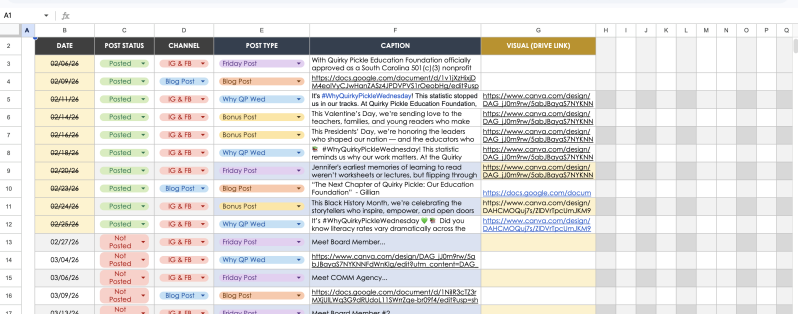
Sample Content Calendar
This content calendar outlines the planned distribution of Quirky Pickle’s digital content across February 2026. It was developed to support consistent brand messaging and audience engagement.
The schedule organizes blog posts, recurring social media series, and bonus content to balance educational storytelling with engaging, trend-driven content that builds community, reinforces brand values, and keeps audiences consistently invested across platforms.
Posts were strategically timed to align with weekly themes, holidays, and campaign milestones, ensuring regular, up-to-date content.
The calendar was built with plans to also put it in a scheduled post system, Buffer. This allows for efficiency, performance tracking, and ongoing optimization of content delivery.
Quirky Pickle Education Foundation
This document is a comprehensive social media and campaign strategy developed for the Quirky Pickle Education Foundation (QPEF), a nonprofit focused on improving literacy and communication access.
The work includes a series of branded Instagram posts, campaign concepts, and community engagement initiatives designed to raise awareness, drive participation, and support classroom resources.
Key elements include the “Make Writing a Big Dill Again” campaign, educator giveaways, literacy-focused content series, and event promotions such as pop-up activations and partnerships.
The strategy blends educational messaging with playful, cohesive branding to make literacy approachable while reinforcing QPEF’s mission of equity, connection, and opportunity through learning.
Reformation Sustainability Campaign
When brainstorming campaign ideas, my partner and I noticed an industry trend toward purpose-driven, authentic communication. Tailoring that trend to fashion marketing, we saw that consumers valued brands that prioritized sustainability.
From there, we developed a mock campaign for Reformation that highlighted their eco-friendly practices, transparent sourcing, and commitment to reducing environmental impact.
This presentation includes all the elements needed for the brand to execute the campaign. From the target audience, objectives & goals, and timeline, to specific strategies such as campaign mottos, influencer partnerships, email marketing, photo shoot direction, website design, a sustainability-centered stylebook, and hashtags for a social media trend to engage conscious consumers.
Through storytelling that emphasized both style and sustainability, the campaign demonstrated how a purpose-driven approach can build trust, deepen customer loyalty, and position a fashion brand as a leader in ethical and environmentally responsible practices.
Note: Page 12 showcases the sustainability meter, created for use under products on the Reformation website. There were icons representing certain sustainability elements that are not pictured here due to file size issues.
Create Your Own Website With Webador